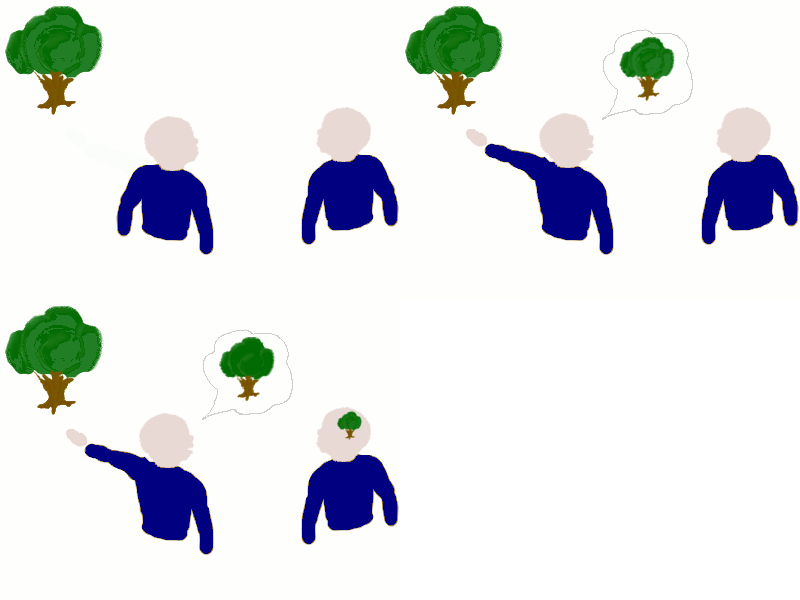
Communication Tip for Autistics

Thought I’d share this little tip that I found helpful (though I tend to forget to follow it). Many autistics have trouble interpreting non-verbal cues, including the unspoken rules of conversation. As a result, they tend to just say what’s on their mind, in a straightforward literal manner. Sometimes, this may come across as insensitive or otherwise inappropriate. Here’s a tip that anyone (including non-autistics) may find helpful in face-to-face communication. I call it the 3-Step Method, but I’m not sure who thought of it first.

Instead of just saying what’s on your mind, think of communication as a 3-step process (I’ll list the steps first, then explain them):

Step 1: Prepare the listener to positively receive what you’re about to say.

Step 2: Deliver the message.

Step 3: Deliver a ‘closer’ that clarifies the message and leaves a positive impression.

Here’s how the 3-Step Method works. Step 1 involves doing and saying things that makes the listener positively receptive to the message. This could be as simple as smiling, saying ‘excuse me’ before asking for directions, or saying something encouraging before delivering bad news. For example, before asking a colleague to do something, you could say something like “I really need your help, and you’re really good at this task”. This makes them feel valued and helpful, rather than feeling like a tool for someone to use. Step 1 is really hard to do. It requires a pretty good ability to put yourself in someone else’s shoes, precisely the ability that is impaired in many autistics. However, it’s still worth the effort to try and work that ’empathy muscle’.

Step 2 is self-explanatory. Step 3 involves clarifying if the listener understood the message, and putting a final positive ‘spin’ on it so the listener gets a good impression. This could be as simple as saying ‘thank you’ after a request, or offering to do something for a colleague after asking for their help. Now you know why I often forget to follow the 3-Step Method! It really is difficult (even for a non-autistic person), but it promotes the good habit of communicating to build relationships rather than just getting things done.

Toy for Autism Spectrum Disorder Wins Good Design Award

A toy designed for autistic children won the 2011 Good Design Award from the Chicago Athenaeum. Designed by Laura Chun Urquiaga, PlanToy’s Build-a-Robot aims to teach facial expressions and enhance dexterity in autistic children aged 3 to 7. Build-a-Robot offers four interchangeable heads, with different emotional expressions and different tactile surfaces. To exercise dexterity, the robot’s head and legs can be detached and re-attached.

Tempaper Self-Adhesive Wallpaper

Painting or wallpapering sounds like a nightmare to me, given my poor coordination and absent-mindedness. No doubt, most autistics with similar traits would feel the same. Tempaper is an interesting alternative. It’s as good as standard wallpaper, but has a self-adhesive backing and is repositionable. Most important of all, it’s removable and (on most walls) doesn’t leave a sticky residue. No glue to spill, no messy brushes and if you make a mistake, just take it off and try again.

Watch Diary

The famous autistic designer Temple Grandin once said that teaching an autistic child to cross the road might involve taking the child to many different roads, and repeating the same instructions over and over. This is because autistics have trouble generalising from experience, applying a lesson learned in one situation to a different situation. A related difficulty is in ‘transposition’, expressing (or understanding) the same meaning in different forms. That’s why the watch diary (pictured below) from Connect Design may appeal to some autistics; because it doesn’t require them to transpose between two different ways of marking the time, on a watch that’s actually running and in a standard diary where times are listed vertically and don’t change. The watch diary has a real watch in the centre, and events are written around the watch face. So an autistic person can immediately see what’s on in ‘real time’, right there on the page. Maybe that’s why, as an autistic, I find it intuitively appealing.

Livescribe Echo Smartpen

Multi-tasking is a challenge for anyone, but especially for many autistics. Some have problems listening and taking notes at the same time. That’s where the Echo Smartpen comes into its own. It records the audio as you take notes, and syncs the recording to the notes. Simply tap in a section of your notes, and the Echo will play what you heard when you wrote that bit. The Echo requires special dotted paper, but you can print it out yourself or buy from the affordable range of Livescribe notebooks.

“EVERY high school and college student with learning disorders involving processing speeds, slow writing, Asperger’s Syndrome, or attentional issues should have and use this product.” [Customer Review]

Defakto One-Handed Watch

This is one of those products that appeal to me personally, but I suspect other autistics would appreciate. It’s a one-handed watch by Defakto of Germany, a simple and logical design. The big indexes indicate hours, and the smaller ones are 15 minute increments. There are several versions (as well as traditional two-handed ones) on the Defakto website. Each watch comes with a two-year guarantee. Dial sizes vary (some are a little large), so be sure to pick a size that’s right for you. Defakto is not the only maker of one-handed watches. Others include Botta and Meistersinger.

Video review courtesy of Word & Wound.

Cosy Calm Weighted Blankets

Difficulty sleeping can be an issue for many autistics, and some find the pressure of a weighted blanket has a calming effect that induces sleep. Apparently, the pressure of the blanket acts like a hug, causing the sleeper’s brain to produce ‘feel good’ hormones such as serotonin, dopamine and melatonin. Cozy Calm weighted blankets are made with medicinal-grade plastic beads that are sewn in so the weight is evenly distributed, with double insulating layers for added comfort. Cozy Calm’s owner, Eileen Parker, is herself autistic and has Sensory Processing Disorder. She couldn’t find the right blanket and started making her own. The rest, as they say, is history. The blankets are custom-made to a specified weight, and a common formula is 10% body weight plus 1 pound. The Cozy Calm site has a weight chart listing the most popular weights ordered.

Soft Clothing for Autistic Children

Many autistics are irritated by the texture of certain fabrics or rough clothing in general (often including seams and labels). Some even resort to wearing clothes inside-out to avoid contact with seams. Thankfully, there’s now a line of clothing for children with such sensory issues. The brand is simply called ‘Soft’, and its clothes have the following special features (according to the company factsheet):

  • Flat seaming for extra comfort
  • Soft cotton combed, peached and bio-washed for extra softness and smoothness
  • Wide collars for a roomy fit around the sensitive neckline
  • Encased elastic waistbands that donʼt pinch
  • Printed labels that donʼt itch
  • Printed details like buttons, zippers, ties, and accessories—allowing children to dress up without discomfort
  • Vegetable dyes, natural enzyme washes, and water-based prints to protect against allergies

For more info, visit their website.